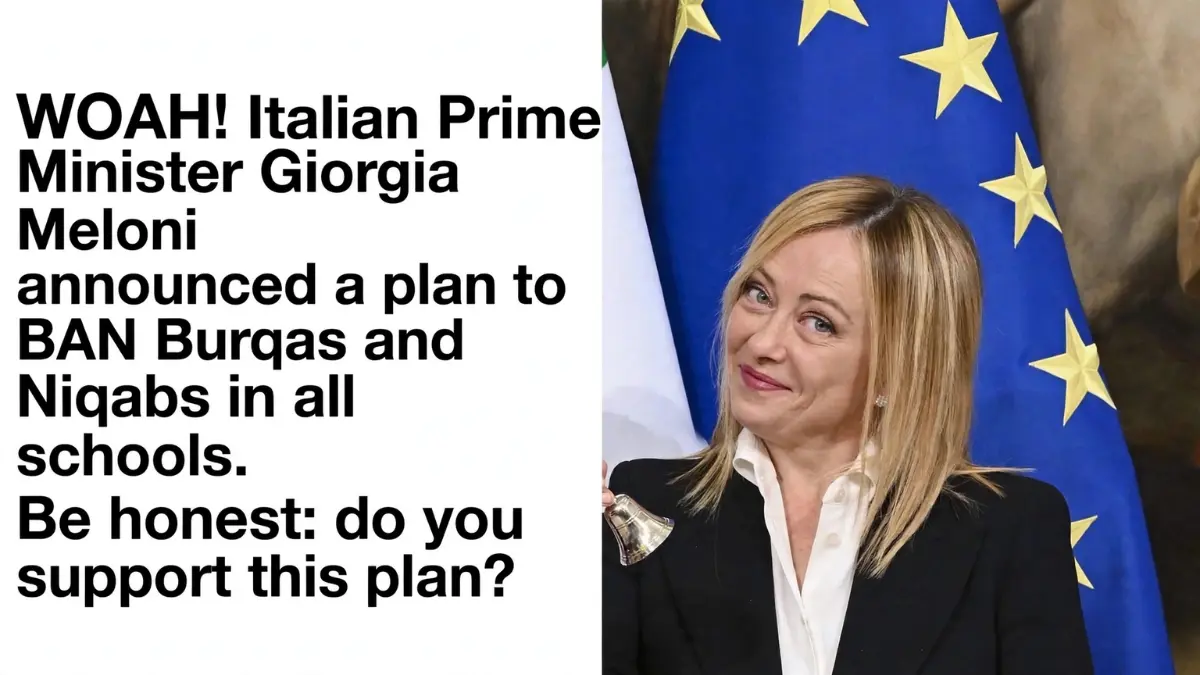
Italy’s PM Giorgia Meloni unveils new school rules banning burqas and niqabs, capping foreign students, and requiring Italian lessons for parents.
Table of Contents
Meloni Announces Plan to Ban Burqas and Niqabs in Italian Schools
Italian Prime Minister Giorgia Meloni has unveiled a new legislative package that would ban burqas and niqabs in schools, cap the number of foreign students per classroom, and require Italian-language lessons for parents whose children struggle to integrate.
What Meloni Announced
Meloni outlined the proposal on September 21, 2026, at a youth-wing gathering of her Brothers of Italy party in Rome. The measures include:
- A ban on burqas and niqabs in educational institutions (hijabs would remain permitted)
- A legal cap on the number of foreign students allowed per classroom
- Mandatory Italian-language classes for parents of students facing “serious integration difficulties”
- A new criminal offense for forcing someone to cover their face, carrying one to two years in prison and fines between €10,000 and €30,000
- A ban on Italian citizenship for anyone convicted under the new offense
“School is attended with one’s face uncovered,” Meloni’s party stated. “No tradition can impose on a young woman the obligation to hide herself.”
Why Now?
The announcement comes as Meloni faces rising pressure from parties further to her right, notably retired general Roberto Vannacci’s National Future party, ahead of Italy’s 2027 general election. Immigration policy is expected to dominate the campaign.
Italy already caps foreign students at 30% per class. Neither the burqa nor niqab is currently banned nationwide, though a 1975 law prohibits face coverings that prevent identification without justified cause — a rule clarified by a 2008 court ruling to allow religious exceptions when identity checks are still possible.
How Italy Compares to Other EU Countries
Italy would join France, Belgium, and Austria in restricting face coverings, though France’s 2011 nationwide public ban remains the strictest model, later upheld by the European Court of Human Rights. Spain and Poland, by contrast, protect such coverings under freedom-of-religion guarantees.
What Happens Next
The proposal must first clear the Italian cabinet, then requires parliamentary approval within 60 days to become law. Critics, including Muslim community advocates, have historically argued similar proposals stigmatize a small population — Italy’s niqab-wearing community has been estimated at under 100 people in past debates — while supporters frame the move as protecting integration and women’s autonomy.
The policy is not yet law, and its final form could change as it moves through parliament.