
Discover the rising trend of “revenge saving” — how and why Americans are prioritizing savings over splurging, plus smart strategies to future-proof your finances.
Table of Contents
Introduction
In 2025, a new financial trend is sweeping the nation: “Revenge Saving.” After years of post-pandemic splurging, many Americans are now turning their focus—and wallets—back to building financial stability. Whether it’s bolstering emergency funds or cementing long-term financial goals, savings have become a new badge of empowerment over indulgence.
1. What Is “Revenge Saving”?
Coined to describe an emotional pivot from reckless spending to purposeful saving, this behavior is driven by economic uncertainty, rising costs, and the need for control over personal finances. Essentially, people are reclaiming agency—by prioritizing savings over consumption.
2. Why It’s Gaining Momentum in 2025
- Economic Anxiety: Trade tensions and inflation have heightened a sense of financial vulnerability.
- Behavioral Shift: Americans are focusing on manageable habits—automated saving, predictable budgets, and controlled spending.
Baby steps—like building emergency funds or paying down debt—are being seen not as sacrifice, but as smart, empowering moves.
3. How Americans Are Doing It
| Strategy | What It Does |
|---|---|
| Automate Savings | Set up automatic transfers into emergency and goal-specific accounts—making saving effortless. |
| Set Clear Goals | Short-term challenges (e.g., “save $500 in 30 days”) build momentum and trackable progress. |
| Stay Flexible | Balance savings discipline with small permitted rewards to avoid burnout. |
| Build Buffers | From budgeting for date nights to covering tuition with a 529 plan, financial clarity is being prioritized. |
4. Why “Revenge Saving” Works
This trend isn’t about deprivation—it’s about security and intention. Whether it’s reducing reliance on credit or planning for early retirement, money moves are becoming emotionally intelligent moves.
Financial advisors emphasize that:
- Goal-oriented saving beats impulse spending.
- Healthcare and debt are less stressful when solvable through buffer funds.
- Saving aligns with long-term wealth strategies, not just short-term comfort.
FAQs
Q1: What exactly is “revenge saving”?
A shift toward aggressive saving behaviors following a period of overspending, meant to reclaim financial control.
Q2: How can I start implementing it now?
Begin with auto-saves, set achievable benchmarks, and allocate discretionary spending—like date nights—to strengthen sustainability
Q3: Is it emotionally driven?
Absolutely. More than budgets, this trend represents a mindset shift—from spending to security.
- 5 Free AI Tools That Can Replace Paid Software in 2026 (And Where They Fall Short)
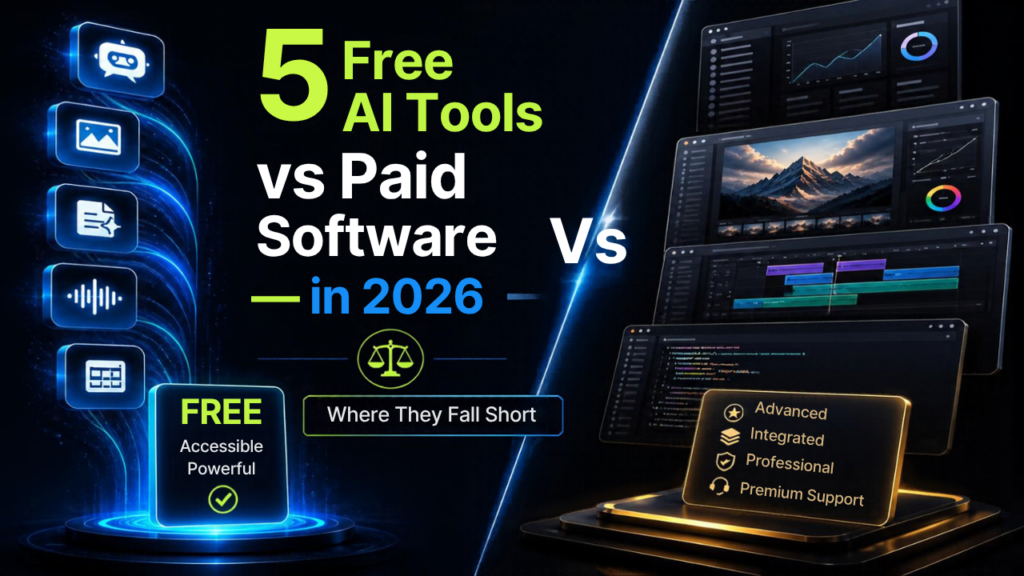
Most “free AI tools” lists make one promise: you will never need to pay again. That is rarely true. Free plans have limits, those limits change, and a tool that fully replaces a paid app for one person only covers half the job for another.
This guide takes a more honest approach. For each of five tools, you get what the free plan realistically covers, which paid software it can stand in for, where it runs out, and who should simply stay on the free plan. Every limit mentioned below was checked against the company’s own help or pricing page where possible, and the sources are listed at the end.
A quick warning before you start: free-plan limits are the part of an AI product that changes most often. In September 2026 alone, one popular design tool was reported to have cut its free AI allowance sharply (details below). Treat any number in any article, including this one, as a snapshot, and confirm it on the official page before you build a workflow around it.
The short version
Tool Can stand in for Free plan covers Biggest catch Gemini A paid AI writing or chat subscription Everyday writing, brainstorming, summaries, study help Compute-based limits and a small context window Gemini Notebook (formerly NotebookLM) Paid research and note-summary tools Up to 100 notebooks, 50 sources each Caps on daily use; visible watermark on generated media in India Gamma Paid presentation-design software Decks, docs and simple sites; export to PDF, PPTX 10 slides per prompt and Gamma branding Canva Entry-level design software Templates and everyday graphics AI usage on the free plan is small CapCut A basic paid video editor Timeline editing, captions, 1080p export Some premium effects and AI tools are limited
1. Gemini: a free AI assistant for everyday writing and study
Might replace: a paid AI chatbot subscription, if your needs are modest.
Google’s Gemini app is free with a Google account. According to Google’s help page, free usage is governed by “compute-based” limits instead of a fixed number of prompts. How much you can do depends on how complex your prompt is, which model and features you use, and how long the chat gets. The limit refreshes every five hours until you reach a weekly limit.
What stands out is how much of the feature list is open to free users. Google’s own comparison table lists Canvas, Gems (custom assistants), quizzes and flashcards, audio overviews, slide generation, Deep Research and image generation as available without a paid plan. Video generation is not.
Where it falls short
- Context window. Free users get 32k tokens. Google AI Plus gets 128k and AI Pro gets 1 million. In practice, a long document or a very long chat will be understood less completely on the free plan.
- Demand-based changes. Google says limits can change without notice, and heavy features such as Deep Research may be unavailable to free users when demand is high.
Stay free if you write emails, outlines, summaries or study notes in short sessions. Consider paying if you regularly feed it very long documents or hit the limit every day.
[ADD YOUR OWN SCREENSHOT: the Usage Limits page in Gemini settings]
2. Gemini Notebook (formerly NotebookLM): research from your own sources
Might replace: paid research-organizer and summarizer apps.
NotebookLM has been renamed Gemini Notebook, and Google’s help pages now use the new name. The idea is unchanged: you upload your own material, such as PDFs, notes and web pages, and the AI answers questions grounded in those sources instead of from the open internet.
On Google’s plan page, the standard (free) tier lists 100 notebooks per user and 50 sources per notebook. Paid tiers raise that to 100 to 600 sources depending on the plan. Daily quotas reset after 24 hours and monthly quotas after 30 days.
Two details most guides skip:
- Privacy. Google says your data is not used to train Gemini Notebook unless you choose to submit feedback. If you do, Google may review the full context of that interaction.
- Watermark in India. Google states that a visible watermark is applied automatically to generated images and videos if you live in India, South Korea or Vietnam. If your audience or your own workflow is in India, plan for that.
Where it falls short: it works only from the sources you give it, so it will not find new information for you, and free-plan usage limits still apply.
Stay free if you are a student, researcher or writer working through a manageable pile of documents.
[ADD YOUR OWN SCREENSHOT: a notebook with 3 to 5 of your own sources]
3. Gamma: presentations from a prompt
Might replace: a paid presentation-design tool for simple decks.
Gamma generates a draft deck, document or small website from a text prompt. According to its pricing page, the free plan lets you create up to 10 slides per prompt, make presentations, docs, websites, social posts and images, import PDF and PPTX files, and export to PDF, PPTX, PNG and Google Slides. The paid Plus plan raises the limit to 100 slides per prompt, removes Gamma branding and adds more advanced image models.
Several independent reviews report that free users get a one-time starting balance of AI credits (commonly cited as 400) that does not refill monthly. Gamma’s pricing page does not state the credit amount in its plan summary, so confirm the current number yourself.
Where it falls short
- Gamma branding stays on free work.
- Reviewers often mention that exported PowerPoint files do not always keep the original layout perfectly, so always check an export before you send it.
- Once starter credits run out, you must either earn more or upgrade.
Stay free if you make occasional short decks and can live with the branding.
[ADD YOUR OWN SCREENSHOT: a 6-slide deck generated from one prompt, before and after your edits]
4. Canva: design without the design software bill
Might replace: entry-level design software for social posts, thumbnails and simple documents.
Canva’s free plan is a real product, not a trial, and its template library is its main strength. The thing to watch is the AI. Pricing trackers reported that in September 2026 Canva reduced the free plan’s AI allowance from “up to 200 standard AI uses or 20 premium uses” to a single combined “up to 20” per month, while paid plans gained unmetered standard AI. Because this comes from third-party tracking and I could not confirm it on Canva’s own page, check the pricing page for the current figure.
How to use it well on a free plan: spend your limited AI uses on the tasks that save the most time, such as background removal or a first draft of text, and do the rest by hand with templates and the normal editor.
Where it falls short: limited AI, and some premium content and brand tools sit behind a paid plan. Students and nonprofits can check Canva’s education and nonprofit programs, which have been reported to unlock most Pro features at no cost.
Stay free if you design a few graphics a week and do not rely on AI generation.
[ADD YOUR OWN SCREENSHOT: your Canva free-plan AI usage meter]
5. CapCut: a free editor with useful AI helpers
Might replace: a basic paid video editor, especially for short-form clips.
CapCut offers timeline editing, effects, transitions, auto-captions and 1080p export on its free plan, according to multiple reviews. The usual trade-offs reported are that some templates and effects are marked Pro and can add a small watermark if you use them, and that AI features such as heavy generative tools can have monthly caps.
Because paywalls move around in video apps, do a short test export before you commit to a project. Check that the final file has no watermark and the right resolution.
Where it falls short: premium assets, 4K export and uncapped AI tools are typically paid. Also check the licensing terms for any music or effect you plan to use commercially.
Stay free if you edit short videos and avoid Pro-labelled effects.
[ADD YOUR OWN SCREENSHOT: a test export showing resolution and no watermark]
How to decide: a simple 7-day test
Do not trust any list, including this one. Test the tools on your own work.
- Day 1: Write down the three paid tools you use or are thinking of buying.
- Day 2 to 3: Redo one real task in each free alternative, not a demo.
- Day 4: Note the first limit you hit (credits, watermark, export, usage cap).
- Day 5: Ask: did that limit block the task, or only annoy me?
- Day 6: Check the official pricing page for what the next paid tier would cost.
- Day 7: Decide. If the free plan blocked real work more than once, upgrade one tool. Otherwise stay free.
Frequently asked questions
Are these tools really free forever? The free plans have no stated end date, but their limits can change at any time. Google says its Gemini limits may change without notice, and one design platform reportedly cut its free AI allowance within a single month.
Can I use free-plan output commercially? It depends on the tool and on any assets inside the project, such as music, templates and stock images. Read each tool’s terms for commercial use before publishing client or monetized work.
Is it safe to upload private documents? Check each tool’s data policy. Google states that Gemini Notebook does not train on your data unless you submit feedback. For confidential files, avoid uploading to any tool whose policy you have not read.
Will free AI tools make my work look generic? They can. Use AI for the first draft and the tedious parts, then add your own examples, numbers and voice.
Sources and where to verify
Official pages (read 9 October 2026):
- Gemini Apps limits and upgrades (Google)
- Gemini Notebook plans and limits (Google)
- Gamma plans and pricing
Check directly before publishing (not confirmed on the official page for this article):
Third-party reporting referenced for context:
- Canva AI usage change, September 2026 (PricingSaaS)
This article is for general information. Prices, limits and features change frequently, so confirm details on each company’s official page.
- I Found 7+ NEW Data Annotation Jobs & Platforms You’ve Never Heard Of (2026) – Work From Home, No Investment
Introduction: Why Data Annotation is the #1 AI Job in 2026
Everyone is talking about AI taking jobs, but very few people know AI companies are PAYING people to train AI. This work is called Data Annotation or AI Training.
Big platforms like Appen and Remotasks are full now. But in 2026, a new class of platforms has risen for RLHF (Reinforcement Learning from Human Feedback) where you don’t just tag images, you teach AI how to think, reason, and be safe. And they pay $15-$40 per hour.
I researched 7+ new platforms that are still underrated, open for India, USA, Canada, and Global, and most people have never heard of them.
What is Data Annotation Work?
You will do tasks like: rating AI answers, writing better prompts, labeling images, checking if AI is biased, or evaluating code. You need good English and attention to detail. No degree needed for most.
Here are the 7+ NEW Platforms:
1. Mindrift (by Toloka) – Best for Beginners
What it is: A platform where you become an AI Tutor. You help train advanced AI models for top companies.
Work: Writing, editing AI responses, domain expert tasks (Math, Science, Coding, Language)
Pay: Advertises up to $30/hour for writers, varies by project. Some reports show $20/hr for non-coding.
Eligibility: Global, including India. Registration takes only a few minutes, no CV needed for many projects.
My Tip: Apply for “All-access projects” first.2. DataAnnotation.tech (Operated by Surge AI)
What it is: One of the most talked-about platforms for AI training work.
Work: Chatting with AI, rating its answers, improving its reasoning
Pay: $20/hour for non-coding tasks, $40+/hour for coding tasks
Eligibility: USA, Canada, UK, India (limited projects), requires English test.
Difference: Pay is slightly lower than Outlier at high end, but project volume is more steady and QA is less aggressive.3. Alignerr
What it is: A newer platform focused on training AI systems through expert feedback across different domains.
Work: RLHF and cognitive labeling, where you evaluate reasoning coherence, ethical safety
Pay: $15-$35/hour, higher for STEM experts
Eligibility: Global. Best if you have a degree in Math, Physics, Law, Biology.
Note: This is for specialized professionals, not just simple tagging. It is transforming annotation into a specialized profession.4. OneForma (by Centific)
Work: AI & Data Projects, multilingual data, search evaluation
Pay: $10-$20/hour
Eligibility: Huge for India – supports 200+ languages. Great for Hindi, Tamil, Telugu speakers.
Why new: Most people only know Appen, but OneForma is hiring heavily in 2026.5. Welodata (Welo Global)
Work: Remote AI/Data annotation, image, video, lidar annotation
Jobs in India link is active and hiring
Pay: $8-$18/hour
Eligibility: India, USA, Europe6. Innodata & RWS Group – Direct Company Jobs (No Fiverr competition)
These are not marketplaces. These are direct companies hiring remote annotators.- RWS: Remote AI/Data Jobs, direct application
- Innodata: Daily Commitment 5-6 hours, Pay Rate reported ∼$350 INR per hour for India roles
Best for: Stable monthly income, not gig work.
7. SuperAnnotate & TaskMonk (Bonus for India)
SuperAnnotate: Expert + Generalist platform for meticulous data labeling
TaskMonk: Allows users to annotate images and texts and supports video annotation, with educational features that allow both college students from Hyderabad and homemakers in Nagpur to participate.How to Apply and Get Selected (Important)
- Don’t apply to all at once. Start with Mindrift and OneForma – easiest qualification.
- For DataAnnotation.tech and Alignerr, you MUST pass the Starter Assessment. Use Grammarly, take your time, explain your reasoning.
- Payment is via PayPal / Wise for all.
Final Words:
Data annotation is not “easy money”. You need patience for qualification. But once in, it is one of the few genuine work-from-home AI jobs that pays in dollars globally.
Here are the 7+ NEW Platforms with Direct Links:1. Mindrift (by Toloka) – Best for Beginners
Direct Link: https://mindrift.ai and https://toloka.ai/mindrift
What to do: Click “Join as AI Tutor” > Choose your domain (Writer, Math, Coding)
Pay: Up to $30/hr2. DataAnnotation.tech (Operated by Surge AI)
Direct Link: https://www.dataannotation.tech
Also: https://www.surgetasks.com (same company)
Pay: $20/hr non-coding, $40+/hr coding
Note: Application is by waitlist + Starter Assessment. Check email daily after applying.3. Alignerr
Direct Link: https://www.alignerr.com
Careers: https://www.alignerr.com/careers
Work: RLHF, evaluating AI reasoning. Needs experts in STEM/Law.4. OneForma (by Centific) – Best for India & Multilingual
Direct Link: https://www.oneforma.com
Jobs Portal: https://oneforma.com/jobs/
Tip: Create profile, complete your languages (English + Hindi + your native). You will get language projects fast.5. Welodata / Welo Data (Welo Global)
Direct Application Links:
India Jobs: https://jobs.lever.co/weloglobal
Global Jobs: https://jobs.lever.co/rws and https://welodata.ai
Pay: $8-$18/hr6. RWS Group & Innodata – Direct Company Hiring
RWS Direct Jobs: https://jobs.lever.co/rws
Innodata Careers: https://www.innodata.com/careers
Innodata India Jobs: Search “Innodata Data Annotator” on LinkedIn Jobs and Foundit.
These are stable jobs, not gigs. 5-6 hours daily commitment.7. SuperAnnotate & TaskMonk (Bonus)
SuperAnnotate: https://superannotate.com/careers
TaskMonk: https://www.taskmonk.ai
iMerit (India Social Enterprise): https://imerit.net/join-our-team/Disclaimer: Pay rates change and depend on project availability and your quality score. This is for information, not a job guarantee.
- Warner Bros Discovery to Reject Paramount Bid as Kushner’s Affinity Exits

Warner Bros. Discovery plans to reject Paramount Skydance’s hostile bid as Kushner’s Affinity Partners exits the takeover battle. Get the full breakdown inside.
Table of Contents
Warner Bros. Discovery Plans to Reject Paramount Skydance Hostile Bid as Kushner’s Affinity Partners Exits Battle
Warner Bros. Discovery is planning to reject Paramount Skydance Corp.’s hostile takeover attempt due to concerns about financing and deal terms, according to Bloomberg reporting. The rejection comes as Jared Kushner’s private equity firm Affinity Partners withdraws from the takeover battle, dealing a significant blow to Paramount’s effort to block Netflix’s agreed $82.7 billion acquisition of the entertainment giant.
Warner Bros. Discovery to Reject Bid
Bloomberg Media and Entertainment Editor Felix Gillette reported that Warner Bros. Discovery is preparing to turn down Paramount Skydance’s hostile offer. The decision reflects serious concerns about the bid’s viability.
People familiar with the matter cited financing concerns and problematic deal terms as key factors driving the rejection. The board appears unconvinced that Paramount’s proposal represents a superior alternative.
The planned rejection signals that Warner Bros. Discovery’s leadership sees greater value in the Netflix transaction than in Paramount’s competing offer.
The Bid Being Rejected
Paramount Skydance’s hostile bid valued Warner Bros. Discovery at $108.4 billion including debt. The offer aimed to disrupt Netflix’s previously agreed acquisition.
Bid comparison:
Offer Valuation Status Netflix deal $82.7 billion Agreed transaction Paramount bid $108.4 billion (with debt) Facing rejection On paper, Paramount’s higher valuation might seem attractive. However, concerns about execution and financing have apparently outweighed the headline number.
Warner Bros. Discovery’s board appears focused on deal certainty rather than maximum stated valuation.
Affinity Partners Exits the Battle
In a significant development, Jared Kushner’s Affinity Partners has withdrawn from the takeover fight. The private equity firm had been helping finance Paramount’s hostile bid.
Affinity’s involvement:
Timeline Development October Affinity Partners joins Paramount effort This month Emerged as participant in hostile bid Now Exiting the battle entirely A representative for Affinity stated that the firm believes the dynamics of an investment have changed since its initial involvement in October. This shift in assessment proved decisive.
The withdrawal removes a key financing source from Paramount’s bid, further weakening its viability.
Why Affinity Changed Course
Affinity Partners’ exit reflects evolving calculations about the deal’s attractiveness. Several factors likely influenced the decision to withdraw.
Possible factors in Affinity’s exit:
- Financing challenges — Deal structure proving difficult
- Valuation concerns — Terms less attractive than initially appeared
- Execution risk — Hostile approach facing obstacles
- Opportunity cost — Capital better deployed elsewhere
- Changed dynamics — Competitive landscape shifting
- Due diligence findings — Deeper analysis revealing issues
The firm’s statement about changed dynamics suggests that what seemed attractive in October no longer appears viable under current conditions.
Private equity firms regularly reassess deals as circumstances evolve. Affinity’s withdrawal follows this pattern.
Financing Concerns Central to Rejection
Warner Bros. Discovery’s planned rejection centers significantly on financing questions. The ability to actually close a deal matters as much as stated valuation.
Financing concerns identified:
Issue Implication Debt structure How acquisition debt would be managed Equity commitments Certainty of investor participation Closing conditions Requirements that must be met Regulatory path Antitrust and approval challenges Synergy assumptions Believability of cost savings claims Affinity’s withdrawal exacerbates these financing concerns. Losing a major financial backer undermines confidence in the bid’s execution.
The Netflix deal presumably offers greater certainty on financing and closing.
Netflix Deal Remains on Track
The rejection of Paramount’s bid clears a path for Netflix’s agreed $82.7 billion acquisition to proceed. That transaction now faces fewer obstacles.
Netflix deal status:
- Originally agreed acquisition remains intact
- Hostile bid challenge apparently failing
- Regulatory review continuing
- Integration planning presumably proceeding
- Timeline moving toward closing
Netflix’s offer, while lower in stated value, apparently provides the certainty and terms that Warner Bros. Discovery’s board prefers.
The streaming giant’s deal would create an entertainment powerhouse combining Netflix’s platform with Warner Bros.’ content library.
Paramount’s Failed Strategy
Paramount Skydance’s hostile approach has encountered significant obstacles. The strategy of disrupting an agreed deal has not succeeded.
Paramount’s challenges:
Challenge Status Target resistance Warner Bros. planning rejection Financing loss Affinity Partners withdrawing Value proposition Board apparently unconvinced Execution path Hostile approach facing headwinds Competitive position Netflix deal providing alternative Hostile bids require either overwhelming value or target vulnerability to succeed. Paramount apparently offered neither sufficient advantage.
The company may need to reassess its strategic options following this setback.
Industry Implications
The takeover battle’s apparent resolution carries implications for the broader entertainment industry. Media consolidation continues reshaping the landscape.
Industry implications:
- Netflix strengthens position as dominant force
- Paramount must find alternative strategies
- Private equity role in media deals questioned
- Hostile approach viability in entertainment challenged
- Consolidation pressure continues industrywide
The Warner Bros. Discovery saga illustrates the high stakes and complex dynamics of entertainment industry dealmaking.
Other potential targets and acquirers will study this battle’s lessons carefully.
What Comes Next
With the hostile bid apparently failing, attention turns to next steps for all parties involved.
Anticipated developments:
Party Likely Next Steps Warner Bros. Discovery Proceed with Netflix deal Netflix Complete acquisition process Paramount Reassess strategic options Affinity Partners Seek other investment opportunities Regulators Continue Netflix deal review The formal rejection, once announced, will mark a definitive moment. Paramount’s options afterward appear limited.
The entertainment industry landscape will be significantly altered once the Netflix transaction closes.
FAQs
Why is Warner Bros. Discovery rejecting Paramount’s bid?
Warner Bros. Discovery plans to reject Paramount Skydance’s hostile bid due to concerns about financing viability and deal terms. The board appears unconvinced that the offer represents a superior alternative to Netflix’s agreed $82.7 billion acquisition despite Paramount’s higher stated valuation.
Why did Jared Kushner’s Affinity Partners exit the deal?
Affinity Partners stated that the dynamics of an investment have changed since the firm became involved in October. The private equity firm was helping finance Paramount’s bid but has now withdrawn, suggesting the opportunity no longer meets their investment criteria.
How much was Paramount’s bid worth compared to Netflix’s offer?
Paramount Skydance’s hostile bid valued Warner Bros. Discovery at $108.4 billion including debt, while Netflix’s agreed deal values the company at $82.7 billion. Despite the higher headline number, Warner Bros. Discovery appears to prefer Netflix’s offer due to greater certainty.
What happens to the Netflix-Warner Bros. deal now?
With Paramount’s hostile bid apparently failing, Netflix’s agreed $82.7 billion acquisition of Warner Bros. Discovery should proceed toward closing. The deal still requires regulatory approval but faces fewer obstacles with the competing bid withdrawn.
What does this mean for Paramount’s strategy?
Paramount must reassess its strategic options following this setback. The hostile approach to blocking Netflix’s deal has not succeeded, and the loss of Affinity Partners as a financing source further limits Paramount’s alternatives in the competitive streaming landscape.
Conclusion
Warner Bros. Discovery’s planned rejection of Paramount Skydance’s hostile bid, combined with Affinity Partners’ exit from the battle, effectively clears the path for Netflix’s $82.7 billion acquisition. The failed hostile takeover attempt illustrates the challenges of disrupting agreed transactions.
Financing concerns and Affinity’s withdrawal undermined Paramount’s effort despite offering a higher stated valuation. Deal certainty ultimately proved more attractive than headline numbers.
The entertainment industry continues consolidating, with Netflix emerging stronger from this battle.
Follow our entertainment business coverage for updates on this developing story. Share your thoughts on media consolidation in the comments below.
- Elon Musk Plans to Launch AI Data Centers in Space

Elon Musk reveals plans to launch data centers in space for AI computing. Learn how orbital facilities could revolutionize artificial intelligence. Read more now.
Table of Contents
Elon Musk Reveals Ambitious Plans to Launch AI Data Centers in Space
Elon Musk has unveiled yet another audacious vision: launching data centers into space specifically designed for artificial intelligence computing. The plans, discussed on Fox Business Network’s ‘Mornings with Maria,’ represent a potential paradigm shift in how AI infrastructure could be deployed. If realized, orbital data centers would address growing constraints facing Earth-based facilities while opening new frontiers for computing power.
Musk Outlines the Vision
Elon Musk’s latest ambitious project involves placing AI computing infrastructure in orbit around Earth. The concept addresses fundamental limitations facing terrestrial data centers.
The SpaceX and Tesla CEO described how space-based facilities could overcome challenges that increasingly constrain AI development. Power, cooling, and physical space all present growing obstacles on Earth.
Musk’s vision leverages his existing SpaceX capabilities to potentially revolutionize computing infrastructure in ways previously confined to science fiction.
Why Space for Data Centers?
The concept of orbital data centers addresses several critical challenges facing AI infrastructure. Understanding these advantages illuminates Musk’s rationale.
Space data center advantages:
Advantage Explanation Unlimited solar power Constant sunlight provides abundant energy Natural cooling Space’s cold vacuum eliminates cooling costs No land constraints Unlimited expansion potential Reduced latency globally Orbital position serves worldwide equally Environmental benefits No terrestrial power grid strain These advantages address the most pressing challenges facing AI data center operators. Energy consumption and cooling represent massive costs for Earth-based facilities.
Musk argued that space deployment, while initially expensive, could prove more economical at scale than terrestrial alternatives.
The AI Power Problem
Artificial intelligence computing demands are straining electrical grids worldwide. This context makes Musk’s space proposal more than mere speculation.
AI energy challenges:
- Explosive demand growth — AI computing power needs doubling rapidly
- Grid limitations — Existing infrastructure struggling to keep pace
- Geographic constraints — Prime locations becoming scarce
- Cooling requirements — Massive energy needed just for temperature control
- Environmental concerns — Carbon footprint of data centers growing
Major technology companies are scrambling to secure power for AI operations. Some have signed deals with nuclear plants. Others are exploring unconventional solutions.
Musk’s space proposal represents perhaps the most unconventional solution yet to this growing crisis.
How It Would Work
Musk outlined the basic concept for how orbital AI data centers might function. The engineering challenges are substantial but potentially solvable.
Operational concept:
Component Approach Launch SpaceX rockets deploying modular units Power generation Large solar arrays in constant sunlight Cooling Radiators dispersing heat into space Communication Laser links to ground and Starlink network Maintenance Robotic servicing and modular replacement Orbit Positioned for optimal coverage and power The concept leverages technologies SpaceX already uses or is developing. Starlink’s satellite manufacturing experience provides relevant capabilities.
Musk suggested that economies of scale from mass production could make orbital deployment economically viable.
SpaceX Capabilities Enable the Vision
Musk’s ability to propose space data centers credibly rests on SpaceX’s demonstrated capabilities. No other entity could realistically attempt such a project.
SpaceX advantages:
- Lowest launch costs in the industry
- Reusable rocket technology proven
- Starlink satellite manufacturing at scale
- Orbital deployment experience
- Starship’s massive payload capacity
- Existing global communication infrastructure
SpaceX launches more mass to orbit than any other organization. This capability makes previously impossible projects potentially feasible.
Starship’s development could further transform economics. The massive rocket promises even lower costs per kilogram to orbit.
Technical Challenges Remain
Despite SpaceX’s capabilities, significant technical challenges would need resolution. Musk acknowledged obstacles while expressing confidence in overcoming them.
Key challenges:
Challenge Difficulty Radiation protection Space radiation affects electronics Latency Speed of light delays for round trips Bandwidth Data transmission to and from orbit Reliability No easy repairs in space Heat management Disposing of waste heat in vacuum Initial costs Massive upfront investment required These challenges are substantial but not necessarily insurmountable. Many parallel problems Starlink already solved for satellite internet.
Engineers would need to develop solutions specific to high-performance computing environments in orbit.
Industry Reaction
The technology and space industries have responded to Musk’s announcement with mixed reactions. Perspectives range from enthusiasm to skepticism.
Reaction spectrum:
- Some see logical extension of current trends
- Others question near-term feasibility
- Competitors monitoring developments closely
- Investors assessing potential opportunities
- Engineers debating technical approaches
- Environmentalists noting potential benefits
The proposal has sparked serious discussion about the future of computing infrastructure. Even skeptics acknowledge that current trajectories are unsustainable.
Whether Musk’s specific vision materializes, the concept has entered mainstream consideration.
Timeline and Investment
Musk provided some indication of potential timelines and investment requirements. The project would represent a massive undertaking even by his standards.
Project parameters:
Factor Indication Timeline Multi-year development before deployment Investment Billions in initial capital required Phasing Likely incremental deployment and scaling Partnerships Potential collaborations with AI companies Customers Major AI developers as anchor tenants The scale of investment suggests this would be a major focus rather than a side project. Serious pursuit would require dedicated resources and organization.
Musk’s track record of pursuing ambitious projects provides some credibility to the timeline suggestions.
Implications for AI Development
If orbital data centers become reality, implications for artificial intelligence development could be profound. Access to computing power shapes AI progress.
AI development implications:
- Potentially unlimited computing capacity
- Reduced constraints on model training
- New possibilities for AI applications
- Democratized access through cloud services
- Accelerated pace of AI advancement
Computing power has historically constrained AI development. Removing those constraints could accelerate progress in unpredictable ways.
The implications extend beyond technical considerations to economic and societal dimensions.
FAQs
Why does Elon Musk want to put data centers in space?
Musk proposes space data centers to address critical challenges facing AI infrastructure including unlimited solar power availability, natural cooling in the space vacuum, no land constraints, and relief for strained electrical grids on Earth that struggle to meet exploding AI computing demands.
How would space data centers be powered?
Orbital data centers would use large solar arrays that receive constant sunlight without atmospheric interference or nighttime interruptions. This provides abundant, consistent power without drawing from Earth’s electrical grids or requiring fossil fuel generation.
What role would SpaceX play in building space data centers?
SpaceX would provide launch services using its low-cost reusable rockets, potentially including Starship. The company’s Starlink satellite manufacturing experience offers relevant capabilities for producing orbital computing hardware at scale.
What are the main challenges for space data centers?
Key challenges include protecting electronics from space radiation, managing communication latency, achieving sufficient data bandwidth between orbit and Earth, ensuring reliability without easy repair access, and managing the massive upfront investment costs required.
When might space data centers become reality?
Musk indicated a multi-year development timeline before deployment could begin. The project would require billions in investment and likely proceed through incremental phases rather than immediate full-scale deployment.
Conclusion
Elon Musk’s vision for launching AI data centers in space represents another audacious bet on technology’s future. The concept addresses real constraints facing Earth-based computing infrastructure as artificial intelligence demands explode.
Whether orbital data centers become reality depends on solving substantial technical challenges and securing massive investment. However, Musk’s track record of achieving seemingly impossible goals demands the concept be taken seriously.
The future of AI computing may indeed extend beyond our planet’s surface.
Follow our technology coverage for updates on space and AI developments. Share your thoughts on orbital data centers in the comments below.
- Markets Update: BofA Bullish on 2026 While CrowdStrike Warns on AI Cyber Risks

Bank of America sees growth sectors for 2026 as CrowdStrike warns AI is increasing cyber threats. Josh Lipton breaks down December 16 market moves. Read more.
Table of Contents
Markets Update: Bank of America Bullish on 2026 While CrowdStrike Warns AI Is Amplifying Cyber Threats
Market Domination anchor Josh Lipton guided viewers through December 16, 2025 market action while featuring two significant expert perspectives. Bank of America Senior Investment Strategist Lauren Sanfilippo shared her bullish outlook for 2026 and identified sectors poised for growth. Meanwhile, CrowdStrike President Michael Sentonas delivered a sobering warning about how artificial intelligence is dramatically increasing cybersecurity risks.
December 16 Market Moves
Josh Lipton opened Market Domination with analysis of the day’s trading activity. Markets navigated multiple crosscurrents as the year-end approaches.
The session reflected investor positioning ahead of 2026 while digesting ongoing economic data. Trading volumes showed typical December patterns with institutional investors adjusting portfolios.
Lipton highlighted key movers and sector rotations that characterized the day’s action, setting context for the expert discussions that followed.
Bank of America’s Bullish 2026 Outlook
Lauren Sanfilippo brought an optimistic perspective for the coming year. The Bank of America Senior Investment Strategist outlined reasons for bullish expectations.
Key bullish factors:
Factor Analysis Economic foundation Fundamentals supporting continued growth Corporate earnings Profit expectations remain healthy Consumer strength Spending patterns encouraging Policy environment Supportive conditions anticipated Valuation opportunities Select sectors attractively priced Sanfilippo’s outlook provides a roadmap for investors planning 2026 strategies. Her institutional perspective carries weight given Bank of America’s market research capabilities.
The bullish call comes as investors weigh opportunities against ongoing uncertainties.
Sectors Positioned for Growth
Sanfilippo identified specific sectors she believes will outperform in 2026. Her selections reflect analysis of economic trends and earnings potential.
Growth sectors highlighted:
- Technology subsectors — Specific areas beyond mega-caps
- Healthcare segments — Benefiting from demographic trends
- Financial services — Interest rate environment favorable
- Industrials — Infrastructure spending beneficiaries
- Select consumer areas — Resilient spending categories
The sector calls give investors actionable guidance for portfolio positioning. Sanfilippo emphasized selectivity within sectors rather than broad exposure.
Her analysis suggests active management and careful stock selection will matter in 2026.
The AI Cybersecurity Warning
CrowdStrike President Michael Sentonas delivered a contrasting message focused on emerging threats. His conversation with Lipton highlighted AI’s double-edged nature in cybersecurity.
Sentonas’s key warnings:
Threat Description AI-powered attacks Hackers using AI to create sophisticated threats Attack velocity AI enabling faster, more frequent attacks Phishing evolution AI-generated content harder to detect Vulnerability discovery AI finding security gaps faster Scale expansion Automation enabling broader attacks Sentonas explained that while AI helps defenders, it equally empowers attackers. The net effect may favor offense over defense in the near term.
The warning carries particular weight from CrowdStrike’s vantage point at the front lines of cyber defense.
How AI Changes the Threat Landscape
Sentonas elaborated on specific ways artificial intelligence is transforming cybersecurity risks. The changes affect organizations of all sizes.
AI threat evolution:
- Deepfake technology enabling impersonation attacks
- Automated reconnaissance of target networks
- AI-generated malware evading traditional detection
- Personalized phishing at unprecedented scale
- Faster adaptation to defensive measures
Traditional security approaches may prove inadequate against AI-enhanced threats. Organizations must evolve their defenses accordingly.
Sentonas emphasized that the threat landscape of 2026 will differ significantly from previous years.
CrowdStrike’s Response to AI Threats
The CrowdStrike president also discussed how his company is adapting to AI-driven threats. Their response involves fighting AI with AI.
CrowdStrike adaptations:
Strategy Implementation AI-powered detection Using machine learning to identify threats Behavioral analysis Recognizing attack patterns automatically Threat intelligence AI processing vast data for insights Automated response Faster reaction to identified threats Predictive capabilities Anticipating attacks before execution Sentonas positioned CrowdStrike as well-prepared for the evolving threat environment. The company’s AI investments aim to stay ahead of adversaries.
His comments also served to highlight CrowdStrike’s competitive positioning in the cybersecurity market.
Investment Implications
The dual perspectives from Sanfilippo and Sentonas carry distinct investment implications. Both inform portfolio decisions for 2026.
Investment takeaways:
Source Implication Sanfilippo (BofA) Equity exposure warranted, sector selection key Sentonas (CrowdStrike) Cybersecurity spending must increase Combined view Tech sector nuanced—security a priority Cybersecurity stocks may benefit from the threats Sentonas described. Organizations will need to increase security spending to address AI-powered risks.
Investors can position for both the growth Sanfilippo anticipates and the security needs Sentonas identified.
Market Context for 2026 Planning
The December 16 Market Domination episode provided valuable year-end context. Investors received both macro outlook and thematic insights.
Planning considerations:
- Overall market environment appears supportive
- Sector rotation opportunities exist
- Cybersecurity as both risk and opportunity
- Active management may outperform passive
- Risk awareness remains important
The combination of bullish macro outlook and specific threat warnings helps investors balance opportunity and caution.
Year-end is traditionally a time for portfolio assessment and 2026 planning.
What Investors Should Watch
Both guests highlighted factors investors should monitor heading into the new year. Their insights point to key indicators.
Monitoring priorities:
Factor Why It Matters Economic data Validates bullish thesis Corporate earnings Confirms profit expectations Cyber incidents Highlights security spending needs AI developments Affects multiple sectors Policy changes Could alter outlook Staying informed on these factors helps investors adjust positions as conditions evolve. The 2026 story will unfold gradually through the year.
Regular reassessment of outlooks ensures portfolios remain appropriately positioned.
Expert Credibility
Both guests brought substantial credentials to their Market Domination appearances. Their perspectives warrant serious consideration.
Expert backgrounds:
- Lauren Sanfilippo — Bank of America Senior Investment Strategist with institutional research resources
- Michael Sentonas — CrowdStrike President with frontline cybersecurity visibility
The combination of macro investment strategy and technology security expertise provided viewers comprehensive perspective.
Josh Lipton’s questioning drew out actionable insights from both experts.
FAQs
What is Bank of America’s outlook for 2026?
Bank of America Senior Investment Strategist Lauren Sanfilippo expressed a bullish outlook for 2026, citing healthy economic fundamentals, supportive corporate earnings, consumer strength, and attractive valuations in select sectors. She identified specific growth sectors for investor consideration.
Which sectors does Bank of America expect to grow in 2026?
Sanfilippo highlighted technology subsectors beyond mega-caps, healthcare segments benefiting from demographics, financial services in a favorable rate environment, industrials benefiting from infrastructure spending, and resilient consumer categories as positioned for growth.
How is AI increasing cybersecurity risks according to CrowdStrike?
CrowdStrike President Michael Sentonas explained that AI is enabling more sophisticated attacks, faster attack velocity, harder-to-detect phishing, accelerated vulnerability discovery, and broader attack scale. While AI helps defenders, it equally empowers attackers.
What is CrowdStrike doing to address AI-powered cyber threats?
CrowdStrike is implementing AI-powered detection using machine learning, behavioral analysis to recognize attack patterns, AI-processed threat intelligence, automated response capabilities, and predictive systems to anticipate attacks before execution.
What should investors consider based on these expert perspectives?
Investors should consider equity exposure with careful sector selection per Sanfilippo’s guidance while recognizing that cybersecurity spending must increase per Sentonas’s warnings. Cybersecurity stocks may benefit from AI-driven threat expansion while broader markets may perform well.
Conclusion
Market Domination’s December 16 edition delivered valuable perspectives for investors planning ahead. Bank of America’s Lauren Sanfilippo provided bullish context for 2026 with actionable sector insights. CrowdStrike’s Michael Sentonas warned about AI’s threat amplification while highlighting defensive opportunities.
Together, these perspectives suggest a 2026 market environment offering growth potential alongside evolving risks requiring attention. Investors benefit from considering both the opportunities and the challenges experts identified.
Josh Lipton’s market analysis and expert interviews equipped viewers with the information needed for informed decision-making.
Follow our market coverage for daily analysis and expert insights. Share your 2026 investment outlook in the comments below.

