US halts penny minting after 232 years citing $2.7 production cost vs 1¢ value. What it means, rounding rules, existing pennies, history. Complete guide!
Table of Contents
United States Halts Penny Production After More Than Two Centuries
Treasury Department Ends Minting of One-Cent Coins Citing Production Costs Exceeding Face Value and Declining Usage
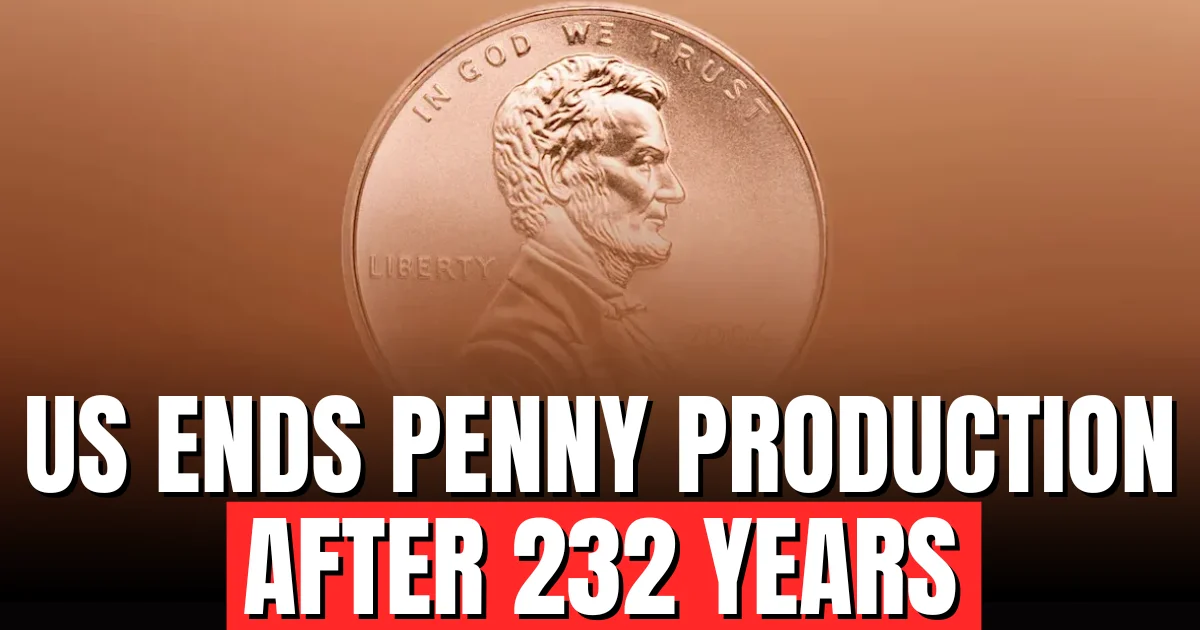
The United States has officially ended production of the penny after 232 years of continuous minting, with the Treasury Department announcing Thursday that the one-cent coin’s production costs, declining circulation, and evolving payment systems make continued manufacturing economically indefensible. The decision marks the end of America’s smallest denomination currency and represents the most significant change to U.S. coinage since the dollar coin’s introduction.
The final pennies rolled off U.S. Mint presses in Philadelphia and Denver on March 31, 2025, concluding a production run that began in 1793 when the first copper cents were struck under the Coinage Act of 1792. Treasury Secretary Scott Bessent characterized the decision as “fiscal responsibility meeting economic reality,” noting that pennies have cost more to produce than their face value for over two decades.
“Each penny costs 2.7 cents to manufacture and distribute,” Bessent stated during the announcement. “We’re literally losing money with every coin we make. With 7.4 billion pennies produced in 2024 alone, that’s a $125 million annual loss taxpayers shouldn’t bear for a coin that 60% of Americans view as more nuisance than necessity.”
The elimination affects one of America’s most iconic symbols, featuring Abraham Lincoln’s profile since 1909, and raises questions about pricing, taxation, charitable donations, and cultural traditions tied to the humble penny. While existing pennies remain legal tender indefinitely, the cessation of new production signals the beginning of the coin’s gradual disappearance from American commerce.
Why End the Penny Now?
Economic Justification
Production Cost Problem:
The penny’s economics have been unsustainable for years:
Manufacturing Costs:
- Raw materials (zinc, copper): 1.8 cents per penny
- Manufacturing process: 0.6 cents
- Distribution to Federal Reserve: 0.3 cents
- Total cost: 2.7 cents per 1-cent coin
Annual Financial Impact:
- 2024 production: 7.4 billion pennies
- Cost: $199.8 million
- Face value: $74 million
- Net loss: $125.8 million
Cumulative Losses:
Since 2006 (when production costs exceeded face value), the U.S. has lost approximately $2.1 billion manufacturing pennies.
Declining Usage
Consumer Behavior Shifts:
Payment Method Changes:
- 67% of transactions now digital (cards, mobile payments)
- Cash transactions: 18% (down from 40% in 2010)
- Checks and other: 15%
Penny-Specific Data:
- 60% of pennies produced never circulate (hoarded at home)
- Average American holds $50-100 in unused pennies
- Businesses report pennies create transaction delays
- Many retailers already round or refuse pennies
Federal Reserve Analysis:
Study found pennies account for 7% of transaction value but cause disproportionate handling costs for banks, retailers, and the mint.
What Happens to Existing Pennies?
Legal Tender Status
Pennies Remain Valid:
- All existing pennies retain legal tender status indefinitely
- Businesses must accept them (within reason)
- Banks continue exchanging pennies
- No recall or redemption deadline
Gradual Phase-Out:
Treasury estimates existing penny supply will naturally decline over 15-25 years through:
- Loss and destruction
- Hoarding by collectors
- Metal recycling
- Foreign export
Rounding Guidelines
Cash Transaction Rounding:
The Treasury Department recommends voluntary rounding rules:
Swedish Rounding (most likely):
- Transactions ending .01-.02 round down to .00
- Transactions ending .03-.07 round to .05
- Transactions ending .08-.09 round up to .10
Example:
- $5.42 → $5.40
- $5.43 → $5.45
- $5.47 → $5.45
- $5.48 → $5.50
Electronic Payments:
Digital transactions maintain exact penny pricing (no rounding required).
Tax Collection:
IRS guidance confirms tax calculations remain to-the-penny accurate, with rounding only at final cash payment.
Public and Political Reactions
Consumer Responses
Mixed Public Opinion:
Support for Elimination (58%):
- Pennies are inconvenient
- Production waste is absurd
- Other countries successfully eliminated
- Digital payments make pennies obsolete
Opposition (31%):
- Cultural icon being lost
- Rounding could increase prices
- Inflation concerns
- Tradition and sentiment
Indifferent (11%):
Political Divisions
Bipartisan Support (Unusual):
Democrats:
“This is long-overdue fiscal responsibility and environmental stewardship. We’re wasting resources on outdated currency.”
Republicans:
“Eliminating wasteful government spending includes pennies that cost 2.7 cents to make. This is common-sense reform.”
Opposition Voices:
Senator from Illinois:
“Abraham Lincoln deserves to remain on circulating currency. This is disrespectful to his legacy and Illinois heritage.”
Zinc Industry Lobby:
Opposed elimination due to impact on zinc sales (pennies are 97.5% zinc).
Industry Impact
Coinstar and Coin Counting:
Companies preparing for transition period with increased penny exchanges before supply dwindles.
Vending Machine Manufacturers:
Already phasing out penny acceptance due to low usage.
Charitable Donation Concerns:
Nonprofits worried about impact on penny drives and coin jar donations.
Historical Context
Penny Production Timeline
1793: First U.S. pennies minted (large copper coins)
1857: Size reduced, composition changed
1909: Lincoln portrait added (first president on circulating coin)
1959: Lincoln Memorial reverse design
1982: Composition changed to zinc with copper plating (rising copper prices)
2006: Production costs exceed face value for first time
2025: Production permanently ended
Previous Elimination Attempts
Congressional Bills:
- 2001, 2006, 2012, 2017, 2019: Bills introduced to eliminate penny
- All failed due to public sentiment and lobbying
- 2024 bill finally passed with bipartisan support
What Changed:
- Production losses exceeded $100 million annually
- Public opinion shifted toward support
- Digital payment adoption reached critical mass
- Fiscal responsibility political priority
International Comparisons
Countries That Eliminated Low-Denomination Coins
Canada (2012):
- Eliminated penny
- Smooth transition with Swedish rounding
- No measurable inflation impact
- Public support increased post-elimination
Australia (1992):
- Eliminated 1-cent and 2-cent coins
- Successful rounding implementation
- Simplified commerce
New Zealand (1990s):
- Progressive elimination of small denominations
- No economic disruption
European Union:
- Many countries eliminated 1-cent and 2-cent euros
- Finland, Netherlands, Belgium, Ireland among adopters
Lessons:
International experience shows penny elimination causes no significant economic disruption and gradually gains public acceptance.
Economic and Cultural Impact
Inflation Concerns
Will Prices Increase?
Economic Research:
Studies from Canada and Australia show no systematic rounding-based inflation:
- Some transactions round up, others down
- Net effect: zero over multiple purchases
- Digital payments maintain exact pricing
- Competitive pressure prevents exploitation
Federal Trade Commission:
Monitoring for price manipulation but expects no issues given international precedent.
Cultural Loss
Idioms and Traditions:
Affected Expressions:
- “A penny for your thoughts”
- “Penny wise, pound foolish”
- “Find a penny, pick it up”
- “Pennies from heaven”
Traditions:
- Penny in shoe (weddings)
- Tossing pennies in fountains
- Penny collections
- “Lucky penny” belief
Historians’ Perspective:
Language and traditions will evolve, just as culture adapted when other denominations disappeared.
What Happens Next
Implementation Timeline
2025:
- Production ceased March 31
- Public education campaign launched
- Rounding guidelines distributed
- Banks prepare for transition
2026-2027:
- Voluntary business adoption of rounding
- Federal Reserve monitors supply
- Collector market for final-year pennies
2028-2030:
- Penny usage declines noticeably
- Most businesses implement rounding
- Nickel becomes lowest denomination in practice
2035-2050:
- Pennies become rare in circulation
- Primarily collector items
- Historic artifact status
Next Coin Elimination?
Nickel Under Scrutiny:
The nickel faces similar economics:
- Production cost: 8.5 cents per 5-cent coin
- Same losing proposition as penny
- Potential future elimination being studied
Dime May Become Base:
Some economists suggest 10-cent minimum for physical currency with digital handling smaller amounts.

Frequently Asked Questions (FAQs)
Are pennies still legal to use after production ends?
Yes, all existing pennies remain legal tender indefinitely with no expiration date. Businesses must accept reasonable amounts of pennies, banks will continue exchanging them, and they retain full 1-cent value. The Treasury Department has not set any deadline for phasing out or redeeming pennies. They will gradually disappear from circulation over decades through natural attrition—loss, hoarding, collecting, and recycling—but remain valid currency for the foreseeable future.
How will cash transactions work without pennies?
Cash transactions will use voluntary rounding to the nearest nickel (5 cents) following Swedish rounding principles: amounts ending in .01-.02 round down to .00, .03-.07 round to .05, and .08-.09 round up to .10. Electronic payments (credit cards, debit cards, mobile payments) will continue using exact penny pricing with no rounding. Studies from Canada and Australia show rounding causes no systematic inflation as increases and decreases balance out over multiple purchases.
Will penny elimination cause prices to increase?
Economic research from countries that eliminated low-denomination coins shows no measurable inflation impact from rounding. While individual transactions may round up or down, the net effect across multiple purchases averages to zero. Additionally, 67% of U.S. transactions are already digital with exact pricing, and competitive market pressures prevent businesses from systematically exploiting rounding. The Federal Trade Commission will monitor for price manipulation, but international precedent suggests inflation concerns are unfounded.
What should I do with pennies I have at home?
You can spend them normally as they remain legal tender, exchange them at banks (most accept coin deposits for account holders), use coin-counting machines like Coinstar (typically 11-12% fee), donate to charities that accept coin jars, or hold them as potential collectibles (especially final-year 2024-2025 pennies). Many Americans have $50-100 in unused pennies, and the transition period represents good opportunity to convert them to usable currency or charitable donations before they become harder to spend.
Why did it take so long to eliminate the penny?
Despite decades of advocacy from economists noting production costs exceeded face value since 2006, elimination faced obstacles including strong public sentiment (Lincoln’s image, cultural traditions), zinc industry lobbying (pennies are 97.5% zinc), political inertia (unwillingness to tackle controversial changes), and lack of crisis forcing action. What changed: annual losses exceeded $100 million, public opinion shifted to 58% support, digital payments reached critical mass reducing penny reliance, and fiscal responsibility became bipartisan priority.
Conclusion: End of an Era in American Currency
The cessation of penny production after 232 years represents pragmatic acknowledgment of economic reality overcoming cultural attachment and political inertia that preserved an obsolete currency denomination for decades past its useful life. The United States joins numerous other developed nations in eliminating its smallest-value coin, recognizing that production costs, declining usage, and digital payment evolution make continued penny manufacturing indefensible.
For most Americans, the practical impact will be minimal. The majority already avoid using pennies when possible, conduct most transactions digitally, and view the coins as nuisance rather than necessity. Cash transaction rounding will go largely unnoticed, and the gradual disappearance of pennies from circulation will occur so slowly that few will mark the transition.
What may be lost is harder to quantify—cultural touchstones, childhood memories of penny candy, the satisfaction of completing a penny jar, and linguistic traditions built around America’s humblest coin. Yet cultures evolve, and just as Americans adapted to losing half-cent coins (1857), two-cent pieces (1873), and three-cent coins (1889), modern society will adjust to a penny-free existence.
The economic case is irrefutable: spending $2.7 to create $1 of value is absurd, and annual losses exceeding $125 million represent government waste few can justify. International precedent confirms elimination causes no economic disruption, while fiscal savings, reduced resource consumption, and streamlined commerce provide tangible benefits.
As the last pennies leave U.S. Mint facilities, they join an honored place in American history alongside other discontinued denominations—reminders of economic evolution and currency systems adapting to changing times. The penny served its country well for over two centuries. But its time has finally, undeniably, come.