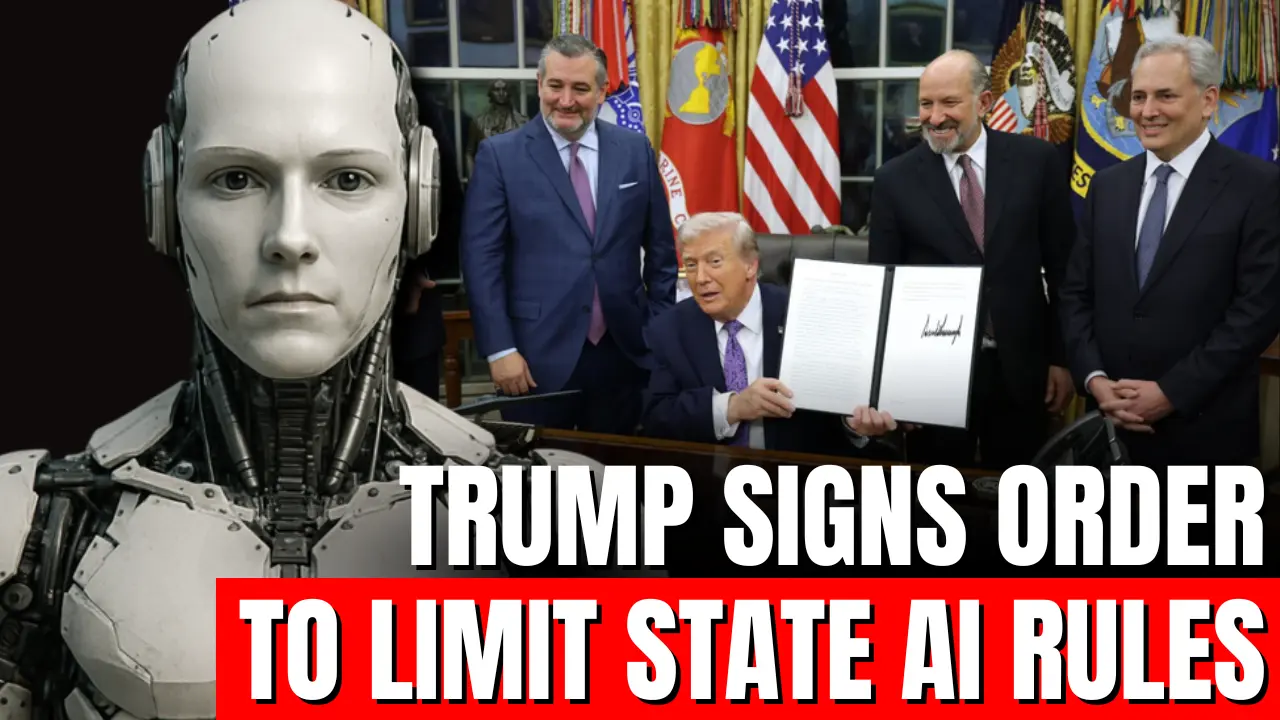
President Trump signs executive order limiting states from creating AI regulations. Learn what this means for tech companies and consumers. Read the full story now.
Table of Contents
President Trump Signs Executive Order Restricting States From Creating Their Own AI Regulations
President Trump has signed a significant executive order that restricts states from developing their own artificial intelligence regulations. The move establishes federal authority over AI governance and prevents the patchwork of state-by-state rules that technology companies have long opposed. The decision carries major implications for how America regulates one of the most transformative technologies in history.
The Executive Order Explained
President Trump signed the executive order aimed directly at limiting state authority over artificial intelligence policy. The action asserts federal primacy in AI governance.
The order prevents states from implementing their own regulatory frameworks for AI systems. Companies operating nationally will face unified federal requirements rather than varying state mandates.
Administration officials characterized the order as promoting innovation while ensuring consistent oversight. Critics immediately raised concerns about reduced consumer protections.
Key Provisions of the Order
The executive order contains several significant provisions affecting AI governance nationwide. Understanding these details reveals the order’s practical impact.
Major provisions include:
| Provision | Effect |
|---|---|
| Federal preemption | States cannot create conflicting AI rules |
| Regulatory uniformity | Single national framework established |
| Existing law status | Some state laws potentially invalidated |
| Enforcement authority | Federal agencies take primary role |
| Business compliance | Companies follow federal standards only |
The order represents one of the most significant assertions of federal authority over technology policy in recent years. Its scope affects virtually every company developing or deploying AI.
Why the Administration Took Action
The Trump administration provided multiple rationales for restricting state AI regulations. Their arguments emphasize economic and practical considerations.
Administration justifications:
- Regulatory fragmentation — Fifty different state rules create chaos
- Innovation protection — Excessive regulation stifles development
- Business burden — Compliance costs multiply with each state
- Competitive position — America must lead global AI race
- Constitutional authority — Federal government controls interstate commerce
Officials pointed specifically to California’s aggressive AI legislation as motivation. They argued that one state shouldn’t dictate national technology policy.
The order aligns with technology industry lobbying that has long sought federal preemption of state regulations.
Technology Industry Response
Tech companies and industry groups have largely welcomed the executive order. Their reactions reflect longstanding preferences for regulatory uniformity.
Industry perspectives:
| Stakeholder | Reaction |
|---|---|
| Major tech companies | Strongly supportive |
| AI developers | Generally positive |
| Industry trade groups | Praised regulatory clarity |
| Startup community | Mixed but leaning supportive |
| Venture capital | Welcomed reduced uncertainty |
Companies had particularly opposed California’s AI Safety Bill and similar state-level efforts. The executive order addresses their core concerns about compliance complexity.
Industry leaders characterized the action as enabling continued American AI leadership against global competitors.
Critics Voice Strong Opposition
Not everyone celebrated the executive order. Consumer advocates, state officials, and some lawmakers expressed serious concerns.
Critical arguments include:
- States lose ability to protect their residents
- Federal standards may prove weaker than state rules
- Corporate interests prioritized over public safety
- Democratic governance undermined by executive action
- Accountability reduced without state oversight
Consumer advocacy organizations warned that the order could leave Americans vulnerable to AI harms without adequate recourse. They questioned whether federal agencies would provide sufficient protection.
Several state attorneys general announced they would explore legal challenges to the order’s constitutionality.
Impact on Existing State Laws
Multiple states had already enacted or proposed AI regulations before this order. The executive action’s effect on these existing laws creates immediate questions.
States with AI legislation affected:
- California’s AI transparency and safety requirements
- Colorado’s algorithmic discrimination protections
- Illinois’s biometric information regulations
- New York City’s automated employment decision rules
- Various state consumer protection AI provisions
The order’s language suggests these laws may face preemption challenges. Legal battles over which state provisions survive seem likely.
Implementation details will determine how existing regulations interact with newly asserted federal authority.
Constitutional Questions Arise
The executive order raises significant constitutional questions about federal versus state authority. Legal experts have offered varying assessments.
Constitutional considerations:
| Issue | Debate |
|---|---|
| Commerce Clause | Does AI regulation fall under federal commerce authority? |
| Tenth Amendment | Are states’ reserved powers violated? |
| Executive authority | Can president preempt state law without Congress? |
| Supremacy Clause | How does federal assertion interact with state police powers? |
Courts will ultimately determine the order’s constitutional validity. Previous technology preemption efforts have produced mixed judicial results.
The path from executive order to settled law likely involves years of litigation.
What This Means for Businesses
Companies developing or deploying AI face a changed regulatory landscape. The order affects compliance strategies and business planning.
Business implications:
- Reduced compliance complexity in the short term
- Federal standards become sole requirements
- State-level penalties potentially eliminated
- Regulatory certainty improved for planning
- Lobbying focus shifts entirely to federal level
Companies that had been preparing for state-by-state compliance may now redirect resources. The simplified landscape benefits larger firms with sophisticated compliance operations.
Smaller companies gain relative advantage from reduced regulatory complexity.
What This Means for Consumers
American consumers experience AI systems across countless contexts. The order affects what protections apply to these interactions.
Consumer considerations:
- State-level AI protections potentially weakened
- Federal standards determine available safeguards
- Complaint and enforcement mechanisms change
- Local accountability channels reduced
- Uniform national protections established
Whether consumers benefit depends on federal standards’ stringency. Strong federal rules could provide better protection than fragmented state approaches. Weak federal rules could leave consumers worse off than under state regimes.
The answer won’t be clear until federal agencies develop detailed regulations.
Looking Ahead
The executive order marks a beginning rather than an end. Several developments will shape AI governance going forward.
Future developments to watch:
- Legal challenges from states and advocacy groups
- Congressional response and potential legislation
- Federal agency rulemaking processes
- Court decisions on preemption questions
- Industry adaptation to new framework
The battle over AI regulation has entered a new phase. Executive action has established a position that courts and Congress will now evaluate.
American AI governance remains very much in flux despite this significant presidential action.
FAQs
What does Trump’s AI executive order do?
President Trump’s executive order restricts states from creating their own artificial intelligence regulations. It asserts federal authority over AI governance and aims to prevent a patchwork of varying state rules that technology companies have opposed.
Can states still regulate AI after this executive order?
The order significantly limits state authority over AI regulation by asserting federal preemption. States may face challenges enforcing existing AI laws and cannot create new conflicting regulations. However, legal challenges may affect implementation.
Why did the Trump administration restrict state AI regulations?
The administration cited regulatory fragmentation concerns, innovation protection, business compliance burdens, competitive positioning against other nations, and federal authority over interstate commerce as justifications for restricting state AI regulations.
How does this executive order affect tech companies?
Technology companies benefit from reduced compliance complexity, facing unified federal requirements rather than fifty different state frameworks. The order addresses longstanding industry concerns about regulatory fragmentation and provides greater planning certainty.
Will courts uphold Trump’s AI executive order?
The order’s constitutionality will likely face legal challenges. Questions about executive authority to preempt state law, commerce clause scope, and states’ rights will require judicial resolution. Previous technology preemption efforts have produced mixed court results.
Conclusion
President Trump’s executive order restricting state AI regulations represents a major shift in American technology governance. The action asserts federal authority while limiting states’ ability to protect their residents through independent AI rules.
Technology companies have welcomed the regulatory simplification. Critics warn that consumer protections may suffer without state-level oversight.
Courts and Congress will ultimately determine whether this executive assertion of authority stands. The future of AI regulation in America remains contested despite this significant presidential action.
Follow our technology policy coverage for updates on this developing story. Share your thoughts on AI regulation in the comments below.