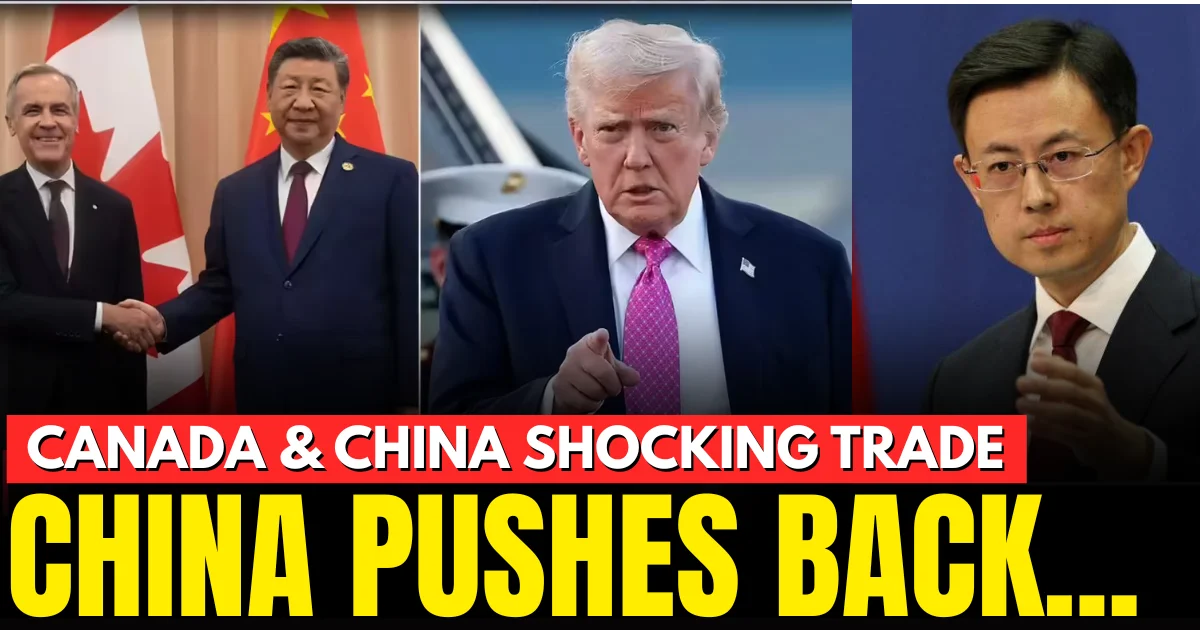
Beijing insists Canada trade agreement doesn’t target America after Trump threatens 100% tariffs. Full deal details and diplomatic responses inside.
Table of Contents
Beijing Insists Canada Partnership Excludes Anti-American Intent Following Trump’s 100% Tariff Warning
Chinese diplomatic representatives firmly denied that their newly established Canadian trade arrangement targets any third nation. This clarification emerged after Donald Trump threatened imposing 100% duties on Canadian goods should Ottawa finalize economic agreements with Beijing.
This escalating transatlantic tension highlights growing fractures in North American trade relationships.
Situation Summary at a Glance
| Element | Details |
|---|---|
| Agreement parties | China and Canada |
| Deal type | Strategic partnership |
| Trump’s threat | 100% tariffs on Canadian products |
| Canadian response | Denies pursuing free-trade deal |
| Key product affected | Canola oil tariffs reduced |
| EV tariff change | Chinese vehicles duty lowered |
| Governing treaty | USMCA notification requirements |
What Did China Officially Declare?
Foreign ministry spokesperson Guo Jiakun addressed international concerns during Monday’s briefing.
Beijing’s Core Position
| Statement Element | Official Language |
|---|---|
| Third-party targeting | “Does not target any third party” |
| Relationship philosophy | “Win-win rather than zero-sum mentality” |
| Mutual benefit | “Serves common interests of both peoples” |
Broader Diplomatic Framing
Jiakun emphasized cooperative international relations philosophy.
Chinese perspective articulated:
Nations should approach bilateral relationships through mutual benefit frameworks rather than competitive elimination mindsets.
Trump’s Tariff Threat Breakdown
The American president issued stern warnings through social media channels.
Truth Social Statements
| Claim | Trump’s Words |
|---|---|
| Tariff threat | 100% duties on Canadian goods |
| China warning | Beijing “successfully and completely taking over” Canada |
| Canada assessment | Country “systematically destroying itself” |
| Port concern | Canada becoming Chinese goods “drop off port” |
Reversal From Previous Position
Trump’s threats surprised Canadian observers.
Noted contradiction:
The president previously characterized potential Canada-China arrangements as “a good thing” before this weekend’s sharp reversal.
Prime Minister Carney’s Response
Canadian leadership pushed back firmly against American characterizations.
Key Denials Issued
| Topic | Carney’s Position |
|---|---|
| Free-trade deal | “Not pursuing” with China |
| Historical consideration | “Never” contemplated |
| American notification | Position “made clear” to US counterparts |
USMCA Compliance Explanation
Carney referenced treaty obligations governing trade negotiations.
Legal framework cited:
Canada must notify America before signing free-trade agreements with “non-market economies” under existing continental trade pact terms.
Process described:
Notification triggers “very open and transparent process” for partner consultation.
Actual Deal Terms Revealed
The Canada-China agreement contains specific tariff modifications rather than comprehensive free-trade provisions.
Canola Oil Tariff Changes
| Metric | Previous Rate | New Rate | Implementation |
|---|---|---|---|
| Chinese duties on Canadian canola | 85% | 15% | By March 2025 |
| Reduction amount | 70 percentage points | – | – |
Electric Vehicle Tariff Adjustments
| Metric | Previous Rate | New Rate | Classification |
|---|---|---|---|
| Canadian duties on Chinese EVs | 100% | 6.1% | Most-favoured-nation rate |
| Scope | Limited number of vehicles | – | – |
Treasury Secretary Clarifies Administration Position
Scott Bessent provided additional context regarding presidential threats.
Clarification Details
| Outlet | ABC News |
|---|---|
| Timing | Sunday interview |
| Trigger condition | Chinese goods dumping through Canada |
| Threshold | “If we see Canadians are allowing” transshipment |
Implied Enforcement Standard
American duties would activate upon evidence of Canada serving as Chinese goods transit point into US markets.
Escalating US-Canada Tensions Timeline
Recent developments reveal deteriorating bilateral relationship.
Friction Points Sequence
| Date | Development |
|---|---|
| Last week | Carney delivers Davos speech |
| Davos remarks | US-led world order “has ruptured” |
| Carney’s call | “Middle powers” should unite against economic coercion |
| Trump response | “Canada lives because of the United States” |
| Board of Peace | Trump withdraws Carney’s invitation |
| Weekend | 100% tariff threats issued |
Diplomatic Language Analysis
Carney avoided naming Trump directly while criticizing “greater powers” employing economic pressure tactics against smaller nations.
Canada’s Trade Diversification Strategy
Ottawa signals strategic pivot reducing American economic dependence.
Carney’s Stated Objective
| Goal | Rationale |
|---|---|
| Portfolio diversification | Reduce US dependence |
| Alternative partnerships | Build resilience |
| Economic sovereignty | Protection from coercion |
Strategic Context
This positioning reflects Canadian concerns about vulnerability to American trade policy volatility under current administration.
USMCA Review Implications
Mandatory treaty evaluation creates negotiation backdrop for current tensions.
Review Framework
| Aspect | Details |
|---|---|
| Treaty parties | United States, Mexico, Canada |
| Review timing | Scheduled for 2026 |
| Trigger | Mandatory 6-year evaluation |
| Stakes | Potential renegotiation or termination |
Carney’s Interpretation
The Prime Minister characterized Trump’s threats as negotiation positioning.
His assessment:
Presidential statements should be understood within broader USMCA review context rather than immediate policy implementation.
Direct quote:
“The president is a strong negotiator, and I think some of these comments and positioning should be viewed in the broader context of that.”
Economic Relationship Data
Understanding the Canada-US trade interdependence scope.
Trade Volume Context
| Metric | Significance |
|---|---|
| Bilateral relationship | Largest US trading partner |
| Daily trade | Billions in goods crossing border |
| Supply chain integration | Deeply interconnected manufacturing |
| Energy exports | Major Canadian petroleum sales to US |
Tariff Impact Potential
100% duties would dramatically reshape North American commerce, affecting consumers and businesses across both nations.
China’s Strategic Interests
Beijing pursues expanded Western economic relationships amid broader geopolitical tensions.
Partnership Objectives
| Goal | Benefit |
|---|---|
| Agricultural imports | Canadian canola access |
| EV market expansion | North American foothold |
| Trade diversification | Reduced US dependence |
| Diplomatic positioning | Western relationship building |
Messaging Strategy
China frames bilateral deals as mutually beneficial arrangements disconnected from third-party competition.
Market and Industry Implications
Specific sectors face significant exposure from tariff developments.
Affected Canadian Industries
| Sector | Exposure Level |
|---|---|
| Canola/agriculture | High – major China export |
| Automotive | Medium – supply chain links |
| Energy | High – US export dependence |
| Manufacturing | Medium – cross-border integration |
Chinese Industry Considerations
| Sector | Opportunity |
|---|---|
| Electric vehicles | Canadian market access |
| Consumer goods | North American distribution |
| Technology | Partnership expansion |
Expert Analysis: Negotiation Tactics vs Policy Reality
Understanding the distinction between rhetoric and implementation.
Tactical Interpretation
| Signal | Possible Meaning |
|---|---|
| Extreme tariff threats | Opening negotiation position |
| Public statements | Domestic political messaging |
| Reversal patterns | Flexibility for deal-making |
| USMCA timing | Leverage for review negotiations |
Implementation Barriers
Actual 100% tariffs would require formal processes, face legal challenges, and trigger retaliatory measures affecting American interests.
Frequently Asked Questions
What trade deal did China and Canada actually sign?
China and Canada established a “strategic partnership” reducing specific tariffs rather than comprehensive free-trade agreement. Canadian canola oil duties drop from 85% to 15% by March 2025. Chinese electric vehicle tariffs decrease from 100% to 6.1% most-favoured-nation rate on limited vehicle quantities.
Why did Trump threaten 100% tariffs on Canada?
President Trump issued tariff threats via Truth Social after learning about Canada-China trade discussions. He expressed concerns about China “taking over” Canada and the country becoming transit point for Chinese goods entering American markets. Treasury Secretary Bessent clarified threats apply specifically if Canada permits Chinese goods dumping.
Is Canada pursuing a free-trade agreement with China?
Prime Minister Mark Carney firmly denied pursuing free-trade arrangements with Beijing, stating Canada has “never” considered such deals. Under USMCA treaty obligations, Canada must notify American counterparts before signing free-trade agreements with non-market economies, triggering transparent consultation processes.
What is the USMCA and why does it matter here?
The United States-Mexico-Canada Agreement governs North American trade relationships with specific provisions regarding member negotiations with outside parties. Mandatory review scheduled for 2026 creates backdrop for current tensions. Carney characterized Trump’s threats as negotiation positioning ahead of this evaluation.
How did Canada respond to Trump’s tariff threats?
Prime Minister Carney dismissed threats as negotiation tactics while emphasizing Canada’s commitment to trade diversification reducing American dependence. He confirmed Canadian officials communicated their position clearly to American counterparts. Carney noted USMCA notification requirements would apply to any actual free-trade negotiations.